Automate Invoice Processing with AI Agents: A CFO Guide
The short answer: start with one process, usually invoice capture. An AI agent reads each invoice, checks it against the purchase order and delivery record, codes it and queues it for approval. People still approve payments and handle exceptions. Once capture runs cleanly, extend the same agent-ready data to bank reconciliation and month-end close. Controls come first, not last: every action is logged, every value links to its source, and nobody’s approval limits change.
Finance teams are under pressure to close faster with the same headcount. Much of their week still goes on reading documents and copying numbers between systems. AI agents can now do that reading and checking with a person in control. This guide is for CFOs and finance controllers deciding where to start. It sits in our Agent Engineering work, where we build agents that run real business processes.
Where do the hours go today?
In most finance teams, three jobs eat the time:
- Invoice capture. Invoices arrive as PDFs, scans and email bodies, in every layout imaginable. Someone opens each one, types the supplier, amounts, tax and dates, finds the purchase order and chases the right approver.
- Vendor and bank reconciliation. Supplier statements and bank lines rarely match the ledger one to one. Part-payments, combined payments, bank charges and missing references all need a person to work out what goes with what.
- Month-end close. Accruals, open items and unexplained differences pile up in the last days of the month, often in spreadsheets kept by one or two people.
The pattern is the same in each: read a document, find the matching record, check the numbers agree, explain the differences. That is exactly the kind of work agents are good at.
What does the agent do, and what does a person still approve?
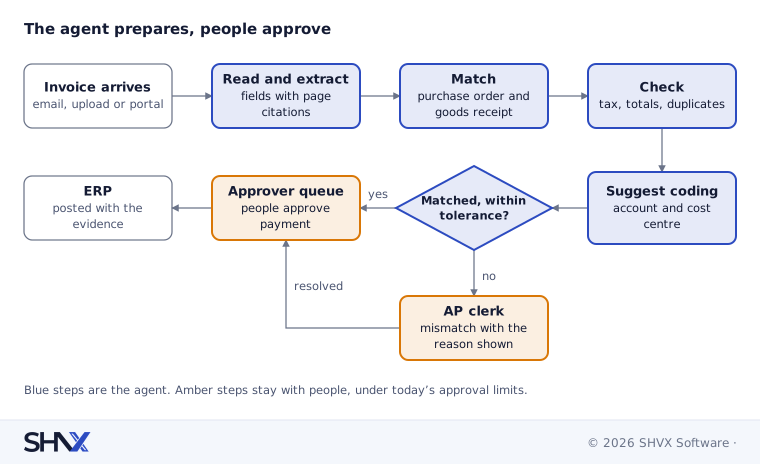
| Step | The agent does | A person does |
|---|---|---|
| Capture | Reads the invoice, pulls out supplier, amounts, tax, dates and lines, cites the page | Nothing, unless the agent is unsure |
| Match | Compares invoice, purchase order and delivery record, flags differences | Resolves the mismatches it flags |
| Code | Suggests account and cost centre from past coding | Confirms or corrects |
| Approve | Routes to the right approver with the evidence attached | Approves payment, as today |
| Reconcile | Proposes matches between bank lines, statements and the ledger | Accepts proposals, investigates leftovers |
| Close | Drafts accruals and explains open differences | Reviews and posts |
What controls will auditors expect?
An agent does not weaken your controls if it is designed in from day one. Auditors will look for:
- Segregation of duties. The agent prepares; people approve. It never approves its own work or releases a payment.
- Approval limits unchanged. The same thresholds and approvers as today, enforced by the system, not by the agent’s judgement.
- Evidence on every value. Each extracted number links back to the page of the invoice it came from.
- A full audit trail. What the agent read, what it proposed, who accepted it and when.
- Duplicate and fraud checks. Same supplier, same amount, similar invoice number, or changed bank details: all flagged for a person.
- Tested before release. The agent’s accuracy is measured on a set of real past invoices before it touches live ones, and re-tested after every change. Our post How to Test AI Agents explains how.
What data must be ready first?
Agents are only as good as the records they match against. Before you start, check:
- The supplier master. Duplicate suppliers, old bank details and missing tax numbers cause most matching failures.
- Purchase order and receipt data. If goods receipts are recorded late or not at all, three-way matching cannot work.
- Coding history. The agent learns suggested codes from how your team coded past invoices. Inconsistent history gives inconsistent suggestions.
- Document quality. Scans, photos and multi-page invoices need a reading pipeline that keeps tables and page numbers, as described in How to Extract Data from Large, Complex Documents with AI.
This clean-up is not wasted effort. The same agent-ready data serves reconciliation, close and reporting next.
How to start with one process
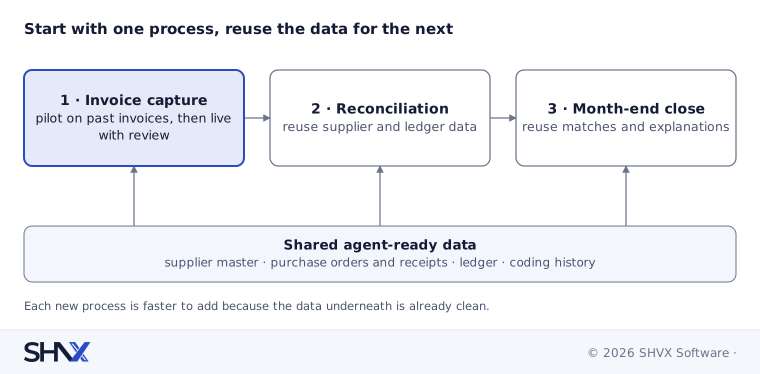
- Pick the process with the most volume and the clearest rules. For most teams, that is invoice capture for purchase-order invoices.
- Test on the past. Run three months of real invoices through the agent and compare its output with what your team actually booked.
- Go live with review on. Every agent decision is checked by a person at first. Lower the review rate only as accuracy is proven.
- Then extend. Reconciliation and close reuse the same supplier, purchase-order and ledger data, so each new process is faster to add.
Our guide to AI in operations explains how to choose between processes across the whole business.
Common mistakes
- Automating everything at once instead of one process.
- Letting the agent approve or pay.
- Skipping the supplier master clean-up.
- Measuring on clean samples instead of real, messy invoices.
- No audit trail of what the agent proposed and who accepted it.
How SHVX can help
Finance team buried in invoices and reconciliations? Pick one finance process. We’ll map it with you, estimate the hours an agent could save, and set out the controls it needs.
Learn more about Agent Engineering.
FAQ
Will an AI agent replace our accounts payable team?
No. It removes the reading and retyping, so the team spends its time on exceptions, supplier queries and control.
Can the agent pay suppliers?
It shouldn’t. Payment approval and release stay with people, under your existing approval limits.
Does it work with our ERP?
Usually, through the ERP’s standard interfaces or file imports. The bigger question is how clean your supplier and purchase-order data is.
Which process should we automate first?
The one with the most volume and the clearest rules, typically purchase-order invoice capture.